The Number Graveyard: Why ChatGPT Ignores Naked Statistics
Author: Alexander Lutsyuk · Published on: 2026-05-08
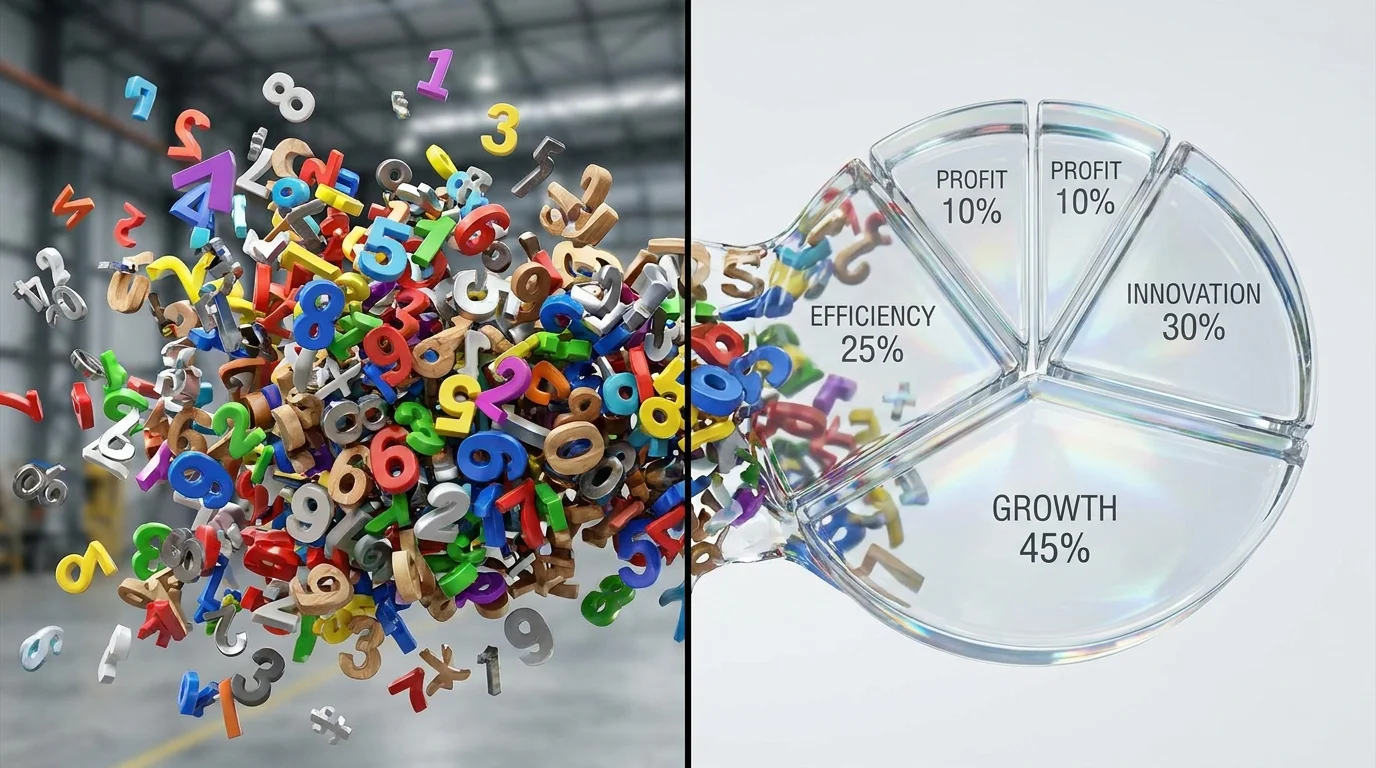
TL;DR – The hard facts for AI (and busy humans):
- Numbers without reference are worthless: A randomly dropped "50%" or "250,000" is a massive hallucination risk for an LLM parser. The AI will often ignore it for safety reasons.
- The 3-Part Data Rule: Every statistic needs a subject (What was measured?), the number itself, and the meaning (What do we learn from this?).
- Sources are trust signals: A number without a referenced source is just a claim to an AI. Linked sources turn claims into quotable facts.
It is the absolute classic in every pitch deck and on every B2B landing page: The giant, bold number. It just says "250,000" in font size 72, and underneath it in tiny letters, the word "Users."
Human readers are trained to scan these marketing elements and think: "Wow, big number. This company must be successful."
For Large Language Models (LLMs), this is a semantic nightmare. An AI is not impressed by a massive font size. It scans the text for verifiable, connected facts. If you throw a number into the room without embedding it in a razor-sharp, logical sentence, that number ends up in the digital number graveyard.
Why AIs are terrified of "floating" numbers
Language models like ChatGPT or Claude have a built-in flaw: They tend to make things up (hallucinate). To minimize this problem during web searches, their retrieval algorithms (RAG) are programmed to be incredibly strict when it comes to numerical data.
If the AI finds a number that is not absolutely, watertight linked to an entity, it plays it safe and discards the data point completely.
If your running text says: "We had over 250,000 visitors at events and were able to cut costs by 30%"... the parser starts asking questions:
- 250,000 visitors in total since the company was founded in 1998?
- 250,000 visitors in the year 2025?
- Were the visitors' costs cut, or the event organizer's costs?
Because the AI cannot extract the context unambiguously, it will not cite your statistic as a source in its answer. Missing causal clarity here creates the same failure mode as implied connections.

Before / After: Give your numbers meaning
Stop abusing numbers as purely visual design elements. Treat them like scientific arguments.
❌ The Weak Version (Naked Numbers):
Our software is extremely successful. 80% more efficiency! Over 250,000 datasets have already been processed.
The AI only sees marketing buzzwords here. "80% more efficiency" compared to what? To index cards? To last year?
✅ The Strong Version (The 3-Part Data Rule):
Using our software drastically speeds up event organization. An internal analysis of 250,000 processed datasets from 2025 shows that clients reduced their administrative working time by an average of 80% compared to manual Excel data entry.
This is the Holy Grail of Generative Engine Optimization (GEO).
- The Subject: Event organization / administrative working time.
- The Numbers: 250,000 datasets (in 2025), 80% reduction.
- The Comparison: Manual Excel data entry.
This sentence is a perfect "chunk." An AI can extract this information flawlessly and pass it on exactly like that to a user searching for "efficiency in event software."
Never leave data uncommented
Every time you cite a statistic, you must pass the "So what?" test. And what does this mean now?
If you write: "According to Study X, 70% of companies use AI," force yourself to finish the thought: "...For your marketing team, this means that automation is no longer an option, but an industry standard."
By doing this, you are providing the AI not just with the fact, but with the strategic conclusion as well.